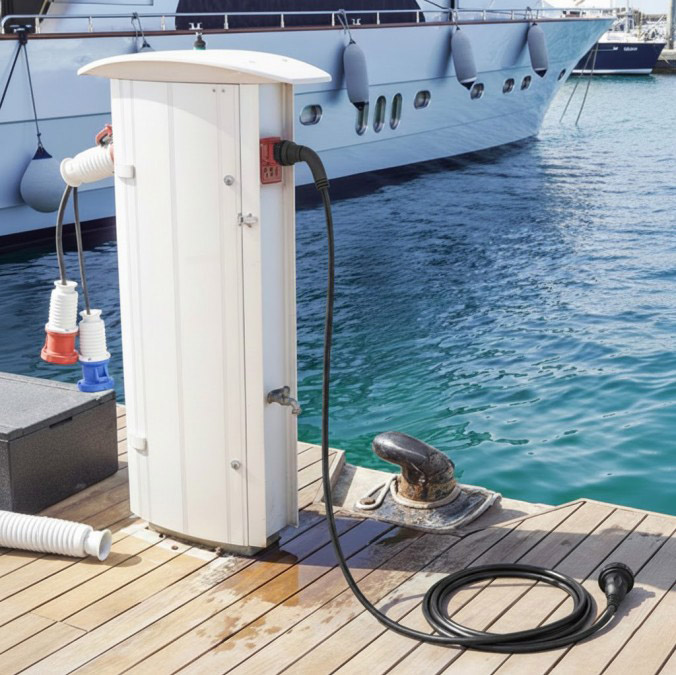
Shore power cords play a vital yet often overlooked role in providing safe and reliable electricity for boats. These flexible cables connect marina power sources to a vessel’s onboard electrical system. When used incorrectly or poorly maintained, they can to severe personal injury, equipment damage, and costly repairs.
The commonly used marine shore power configurations are 30A 125V (NEMA L5-30) and 50A 125/250V (NEMA SS-2). Each plug type is intentionally designed to prevent mismatching. As long as the locking, L-shaped terminals remain intact, connecting the wrong power source is difficult. However, altering or forcing a 30A plug into a 50A receptacle can result in serious electrical hazards.
Using incompatible plugs, improvised connections, or damaged cords may allow electrical current to leak into the surrounding water. Such leakage often does not trigger circuit breakers and can pose life-threatening risks to swimmers. It can also cause accelerated corrosion of boats, docks, and mooring systems. A single vessel with a faulty neutral or ground connection may to widespread electrolysis throughout the marina, damaging propellers, rudders, outdrives, and underwater fittings.
Electrical leakage is especially dangerous in freshwater environments. Unlike saltwater, which conducts electricity efficiently to ground, freshwater allows electrical fields to form around vessels. Even minimal current levels can immobilize swimmers, increasing the risk of drowning.
Visible corrosion on shore power plugs usually indicates saltwater exposure or excessive electrical load. Although a 30A shore power cord is rated accordingly, continuous usage above 20–25A can cause overheating at the terminals. Over time, this heat increases resistance, forcing the system to draw even more current to meet power demands—similar to increasing pressure to compensate for a partially kinked hose. This inefficiency may also contribute to higher energy consumption, particularly during winter months.
Use only UL-Marine listed shore power cords and never substitute them with household extension cables. Always fully lock plugs and ensure connectors are molded or sealed to prevent water intrusion. Turn off dockside and onboard breakers before connecting or disconnecting, and connect the boat end first. Avoid adapters whenever possible, inspect cords regularly for wear or corrosion, store them in loose coils, and replace damaged or stiff cords promptly.
Shore power cords are simple devices, but proper handling and routine maintenance are essential. With basic precautions, they can deliver dependable, safe power while extending service life. Building on these fundamentals, Well Electric offers shore power cords in multiple NEMA configurations—such as L5-30, SS2-50, TT-30, and 14-50 to suit a wide range of marine and RV applications, featuring durable, water-resistant construction for long-term, reliable use.


 English
 中文简体
中文简体

 NO.565,South of Xihuan Rd,Yuyao City Zhejiang China.
 0086-574-62599999/62593088
 0086-574-62598888
 ryan.yu@nbwell.com